Loading…
Peoples and ways of life · book
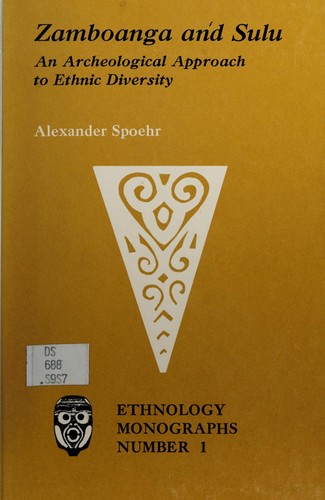
Zamboanga and Sulu
An Archaeological Approach to Ethnic Diversity
- Year
- 1973
- Language
- English
- Pages
- 298
- Availability
- Out of print
No longer sold new: look for it in a library, or for a used copy.
About the book
Excavations and surveys in Zamboanga and Sulu read for what they say of how the region’s peoples came to differ.
Alexander Spoehr uses archaeology to give historical depth to the peoples of the southern Zamboanga peninsula and the Sulu archipelago: the Zamboangueños, Subanun, Tausug, Badjau and Samal-speaking groups. He treats them not as isolated tribes but as societies linked by exchange. Land and forest goods from the Zamboangueños and Subanun met the sea products and trade goods of the Tausug and Samal, and control of trade shaped who held power, with the Tausug sultans and datus at the top.
Spoehr surveyed and dug at Fort Pilar, at rock shelters and caves on the east coast of Zamboanga City, at forts around Parang on Jolo, whose plans he reconstructed, and on Sanga-Sanga in Tawi-Tawi, where finds date to between 5995 and 6650 BC. The rest of the book compares pottery, stone tools, shell ornaments, brass and grave markers. His pottery finds question the archaeologist Solheim's threefold division of Philippine pottery.
It was the first Ethnology Monograph of the University of Pittsburgh's Department of Anthropology, published in 1973, with 298 pages. Eric Casiño reviewed it in Philippine Studies in 1977, and Karl Hutterer in the Journal of Asian Studies.
Peoples and ways of lifeHistory
Cover from Open Library, shown to identify the book; its rights stay with the publisher.
On the same shelf
1973In print
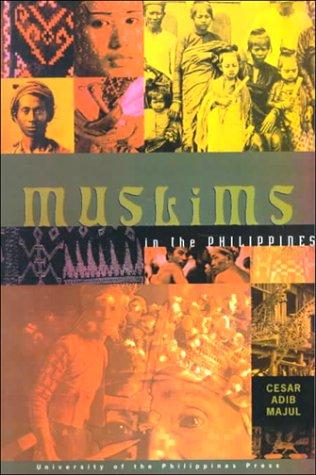
Muslims in the PhilippinesCesar Adib Majul
The standard history of the Muslim peoples of the Philippines: the coming of Islam, the sultanates of Sulu and Maguindanao, and three centuries of Spanish wars against them, told from the Moro side of the record. Reissued by the University of the Philippines Press in 1999.
1905Free to read
Studies in Moro History, Law, and ReligionNajeeb M. Saleeby
The first English account of Maguindanao’s genealogies and of the law codes and Islam of Maguindanao and Sulu, translated by an American colonial official who read the originals. Out of copyright and free to read.
1908Free to read
The History of SuluNajeeb M. Saleeby
Sulu from its earliest written genealogies to the American arrival, drawn from the sultanate’s own documents, Spanish records and the author’s years in Jolo. Out of copyright and free to read.
1977Out of print
Mandate in MorolandPeter G. Gowing
How the United States ruled the Moro Province and the Department of Mindanao and Sulu, from the Bates Treaty to the start of Filipinization, from the records of the men who governed. Reprinted by New Day in 1983.
1979Out of print
Muslim Filipinos: Heritage and HorizonPeter G. Gowing
A general introduction to the Muslim peoples of the Philippines, their history, faith and institutions and their place in the republic, written for Filipino readers from the Dansalan Research Center in Marawi.
1981In print
The Sulu Zone, 1768–1898James Francis Warren
The Sulu Sultanate at its height as a trading state: the China trade in sea produce, the slave raiding that fed it, and the peoples it drew in, from Spanish, British and Dutch archives. The book that made the Sulu Zone a field of study. Second edition 2007.