Loading…
Economy and development · report
Beyond the Numbers
Sustaining Poverty Reduction in BARMM (Philippines Economic Update, June 2024)
- Publisher
- World Bank
- Year
- 2024
- Language
- English
- Pages
- 82
- Availability
- Free to read
Published free: the link opens the whole book.
About the book
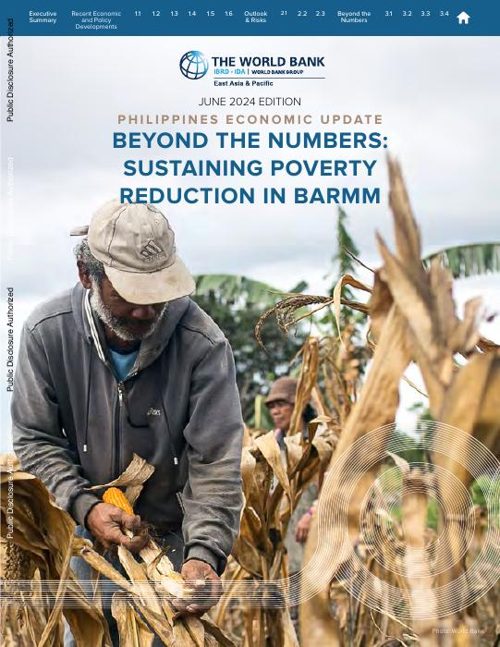
An edition of the World Bank's Philippines Economic Update whose special focus is poverty in the BARMM. It looks at how poverty in the region fell and what is needed to keep it falling.
This edition of the World Bank's Philippines Economic Update has 3 parts. Parts 1 and 2 cover the national economy and its outlook. Part 3 is a special study of poverty in the BARMM between 2018 and 2021.
It finds that poverty in the region fell by 24.6 percentage points over that time, against the national trend and during the pandemic. The report links the fall to the peace that came with the Bangsamoro Organic Law and to more public funds. Higher wages from a shift out of farming explain nearly 40% of the drop. Private and government transfers explain about half.
The BARMM is still the poorest region. It holds 4% of the country's people but 8% of its poor, and 36% of its people are near-poor. The report points to gaps in water, electricity and access to markets, and suggests ways to keep poverty falling.
From documents.worldbank.org.
Cover from the publisher’s PDF, shown to identify the book; its rights stay with the publisher.
On the same shelf
1981In print
The Sulu Zone, 1768–1898James Francis Warren
The Sulu Sultanate at its height as a trading state: the China trade in sea produce, the slave raiding that fed it, and the peoples it drew in, from Spanish, British and Dutch archives. The book that made the Sulu Zone a field of study. Second edition 2007.
1994Out of print
The Minoritization of the Indigenous Communities of Mindanao and the Sulu ArchipelagoB. R. (Rudy) Rodil
How the Moro and Lumad peoples became minorities in their own homeland: the land laws, the resettlement programmes and the migration from Luzon and the Visayas, with the figures.
2004Free to read
The Moro ConflictEric U. Gutierrez and Saturnino M. Borras Jr.
The argument that land, not religion, is at the root of the Moro conflict: how colonial and Philippine land policy dispossessed the Moros and why the peace deals have not touched it. Free to read.
2014In print
Insurgents, Clans, and StatesFrancisco J. Lara Jr.
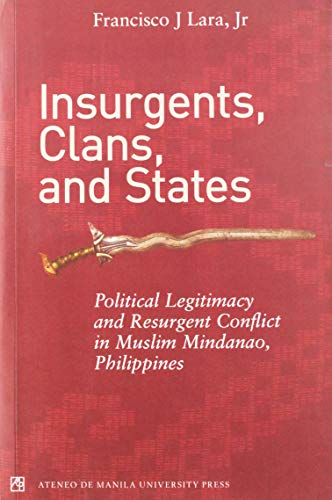
Why the conflict keeps returning: the clans, the rebel fronts and the state as rival sources of authority in Muslim Mindanao, and the shadow economy that sustains all three.
2013Free to read
Out of the Shadowseds. Francisco J. Lara Jr. and Steven Schoofs
The shadow economies of Mindanao, from guns and drugs to the informal credit and trade that ordinary people live by, and how they feed and are fed by the conflict. Free to read.
2003Free to read
Breaking the Links between Economics and Conflict in MindanaoInternational Alert
A discussion paper on the economic roots of the Mindanao conflict and what business and donors could do about them. Free to read.
More from World Bank
2003Out of print
Human Development for Peace and Prosperity in the Autonomous Region in Muslim MindanaoTeresa J. Ho
A World Bank study of health, education and social services in the ARMM, the country's poorest region. It argues that better human development is needed for peace and growth in Muslim Mindanao.
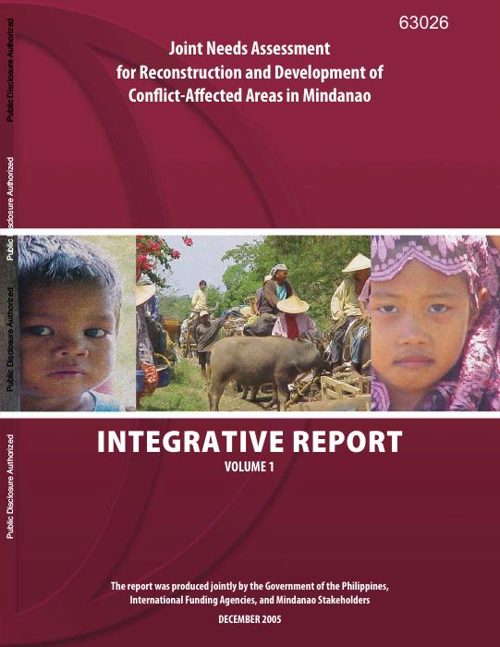
2005Free to read
Joint Needs Assessment for Reconstruction and Development of Conflict-Affected Areas in MindanaoWorld Bank
The main report of a large needs assessment of conflict-affected areas of Mindanao, made jointly with the government, international agencies and local stakeholders. It sets out what reconstruction and development would need after a peace agreement with the MILF, and led to the Mindanao Trust Fund.
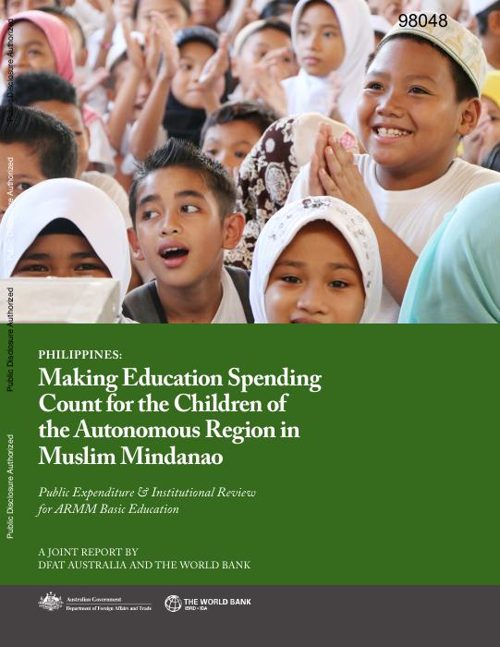
2015Free to read
Making Education Spending Count for the Children of the Autonomous Region in Muslim Mindanao (ARMM)World Bank
A review of how public money for basic education is spent and managed in the ARMM, where learning outcomes are the lowest in the country. It recommends ways to make that spending reach schools and children.
2019Free to read
Unlocking the Potential of the Bangsamoro People through the Alternative Learning SystemWorld Bank
A World Bank report on the Alternative Learning System, the second-chance education programme for out-of-school youth and adults, in the Bangsamoro region. It looks at who needs it and how the new BARMM can expand and improve it.
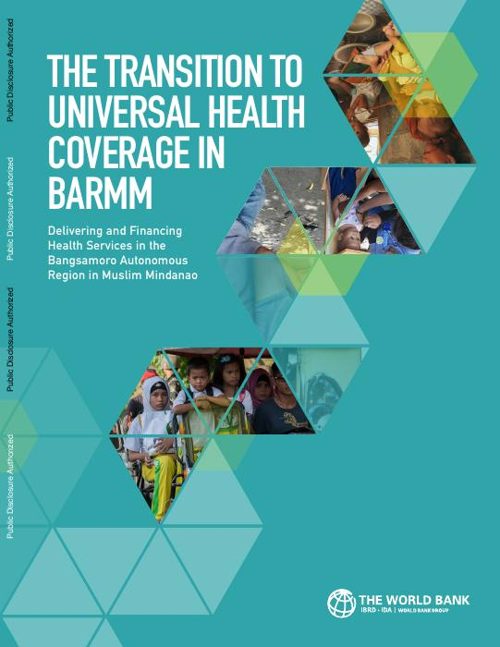
2020Free to read
The Transition to Universal Health Coverage in BARMMWorld Bank
A long study of how health services are delivered and paid for in the BARMM as the region takes up the national Universal Health Care law. It maps gaps in facilities, staff and financing and sets out options for the new regional Ministry of Health.