Loading…
Peoples and ways of life · book
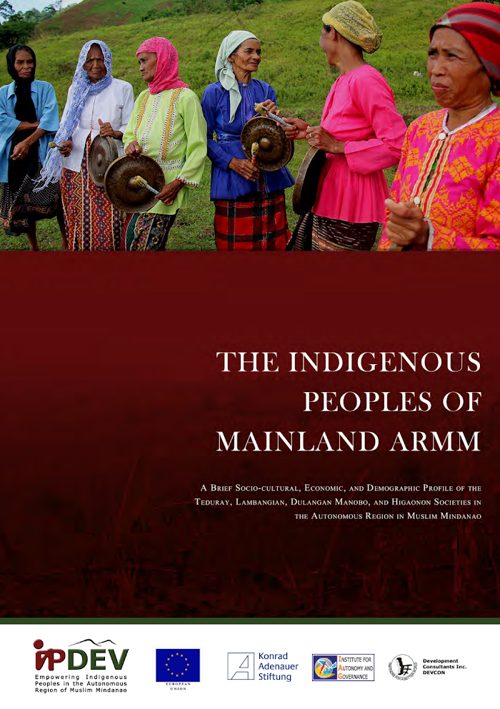
The Indigenous Peoples of Mainland ARMM
A Brief Socio-cultural, Economic, and Demographic Profile of the Teduray, Lambangian, Dulangan Manobo and Higaonon Societies in the Autonomous Region in Muslim Mindanao
- Publisher
- Konrad-Adenauer-Stiftung Philippines
- Year
- 2014
- Language
- English
- Pages
- 52
- Availability
- Free to read
Published free: the link opens the whole book.
About the book
A short profile of the non-Moro indigenous peoples living in mainland ARMM: the Teduray, Lambangian, Dulangan Manobo and Higaonon. It covers their society, culture, economy and population, and was made with EU support.
This short profile reports a survey of the indigenous peoples of Maguindanao and Lanao del Sur, the mainland part of the old ARMM. It came out of IPDEV, a Konrad-Adenauer-Stiftung project with EU funding on the rights of indigenous peoples in the ARMM. Its partner DEVCON ran the survey from August 2012 to February 2013 in 80 barangays across 12 municipalities.
It counted 117,189 people in 15,510 households. Of these, 110,559 were Teduray, 3,139 Lambangian and 2,905 Dulangan Manobo, along with 587 people from 17 other groups, including the Higaonon, who settled in Wao, Lanao del Sur. Together they made up about 6% of the 2 provinces' population. Sections cover households, education, housing, health, livelihoods, income and land titles.
The conclusion finds these peoples poor and marginal, with the rights promised by the Indigenous Peoples Rights Act still unrealised. It says they hold an identity distinct from both the Bangsamoro and Christian settlers. A list of the 80 barangays is included.
From drive.google.com.
Cover from the publisher’s PDF, shown to identify the book; its rights stay with the publisher.
On the same shelf
1979Out of print
Muslim Filipinos: Heritage and HorizonPeter G. Gowing
A general introduction to the Muslim peoples of the Philippines, their history, faith and institutions and their place in the republic, written for Filipino readers from the Dansalan Research Center in Marawi.
2002In print
Iranun and BalangingiJames Francis Warren
The Iranun and Balangingi raiders of the eighteenth and nineteenth centuries, the world economy that called their raiding into being, and how a way of life became an ethnic name.
1991Out of print
The Institutions of MaguindanaoGhislaine Loyré
The sultanate, the datus, the law and the ranks of Maguindanao society, set out from Spanish sources and the author’s ethnographic fieldwork.
2007In print
Mindanao Ethnohistory beyond NationsShinzo Hayase
Maguindanao, Sangir and Bagobo as peoples of one sea rather than of two countries, in a history that crosses the border with Indonesia the way they did.
1993Out of print
The Lumad and Moro of MindanaoB. R. (Rudy) Rodil
A short report for an international readership on the two peoples displaced by the settlement of Mindanao and the state of their claims in the early 1990s.
2007Free to read
Ridoed. Wilfredo Magno Torres III
The first systematic study of rido, the clan feuds that take more lives in Muslim Mindanao than the rebellion, with case studies from Lanao, Maguindanao, Sulu and Basilan and the ways communities settle them. Expanded edition from Ateneo de Manila University Press in 2014; the original is free to read.
More from Konrad-Adenauer-Stiftung Philippines
2004Out of print
Beyond Paper AutonomyBenedicto R. Bacani
A study of why Muslim autonomy in the southern Philippines has stayed largely 'on paper', and what real self-rule for the ARMM would require. It includes the text of the 1976 Tripoli Agreement.