Loading…
War and conflict · report
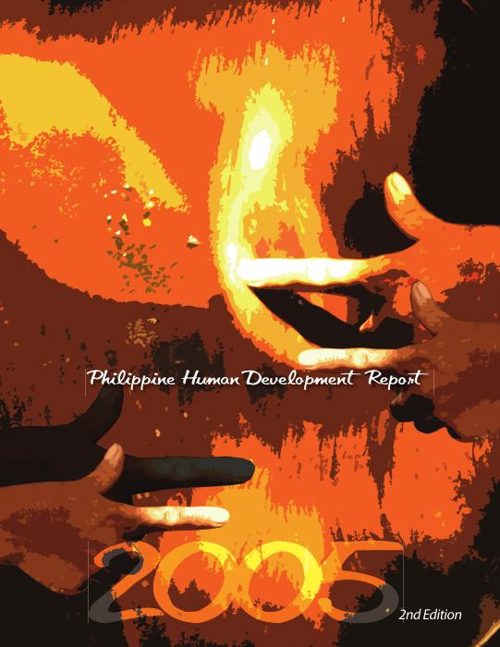
Philippine Human Development Report 2005
Peace, Human Security and Human Development in the Philippines
- Publisher
- Human Development Network
- Year
- 2005
- Language
- English
- Pages
- 165
- Availability
- Free to read
Published free: the link opens the whole book.
About the book
The 2005 national human development report, devoted to the costs of armed conflict in the Philippines, including the Moro conflict and the communist insurgency. It treats human security as a precondition of human development and examines prejudice against Muslims as a driver of conflict.
The 5th Philippine Human Development Report turns from economics to armed conflict. It looks at the causes and costs of the communist and Moro insurgencies, why government policy has failed to end them, and how peace efforts could be strengthened. The Human Development Network prepared it with UNDP and New Zealand aid. Emmanuel de Dios and Soliman Santos Jr. wrote the main chapter, drawing on commissioned papers, case studies, workshops including one at MSU General Santos, and a national opinion poll.
Among its findings: 91% of provinces were hit by armed conflict between 1986 and 2004. The Mindanao conflict cost an estimated P5 billion to P10 billion a year from 1975 to 2002. Between one-fifth and one-third of the major Muslim groups now live outside their ancestral homelands. Polls showed latent anti-Muslim bias among 33% to 39% of Filipinos. Poverty rates alone did not predict where fighting happened, but gaps in water, power and schooling did.
The report calls for a common peace framework, a national peace policy set in law, and a national constituency for peace.
From hdr.undp.org.
Published with the UN Development Programme.
War and conflictEconomy and developmentPeace process
Cover from the publisher’s PDF, shown to identify the book; its rights stay with the publisher.
On the same shelf
1985Out of print
The Contemporary Muslim Movement in the PhilippinesCesar Adib Majul
Majul’s short account of the Moro struggle of the 1970s and the rise of the Moro National Liberation Front, written for readers abroad.
1981In print
The Sulu Zone, 1768–1898James Francis Warren
The Sulu Sultanate at its height as a trading state: the China trade in sea produce, the slave raiding that fed it, and the peoples it drew in, from Spanish, British and Dutch archives. The book that made the Sulu Zone a field of study. Second edition 2007.
1994Out of print
The Minoritization of the Indigenous Communities of Mindanao and the Sulu ArchipelagoB. R. (Rudy) Rodil
How the Moro and Lumad peoples became minorities in their own homeland: the land laws, the resettlement programmes and the migration from Luzon and the Visayas, with the figures.
2000Out of print
Kalinaw MindanawB. R. (Rudy) Rodil
The twenty-one years of talks between the government and the Moro National Liberation Front, from Jeddah to the 1996 Final Peace Agreement, by a historian who sat on the government panel.
1980Out of print
Revolt in MindanaoT. J. S. George
A journalist’s account of the Moro revolt of the 1970s, the MNLF and the Marcos government’s war, written as it happened.
1990Out of print
Muslim SeparatismW. K. Che Man
The Moro and Patani Malay movements side by side: their histories, their organisations and what each state did about them, in the first full comparison of the two.